
How writers gaslight themselves
If you've ever questioned yourself as a writer, this is for you

I was reading and replying to email from readers when it dawned on me how quick writers are to gaslight themselves. I see it over and over again.
Funny thing is, gaslighting wasn’t even a word until the movie came out. It came from a 1944 film where a man is trying to make his wife have a mental breakdown. He uses a lot of different ways to make her question her mind, but the lights were the big one. She’d see the gas lights flickering and he’d tell her she’s imagining it, the lights aren’t flickering. Look at her like she’s crazy until she believed it.
The internet loves to fling that word around. Particularly about narcissists. Oooh, he’s gaslighting you. Narcissist! Truth is, we do it to ourselves a lot. Especially writers.
Let me explain so that makes sense, okay?
When readers subscribe to my Substack, I send a quick hello and I ask hey, what are you struggling with right now? I get some really fascinating letters and have found some writers that I wouldn’t have found any other way.
But the other morning it really struck me how many writers gaslight themselves.
They say stuff like
… What do I have to say that anyone would want to read?
… I don’t have expertise in anything, why would anyone want to read what I write?
… What can I possibly write about that someone hasn’t said already or better?
… What would make anyone want to read my writing, I’m a nobody.
Know what it makes me think of?
Makes me think of Arnold Samuelson. You’ve probably never heard of him. Most people haven’t, and rightfully so. Because he gaslit himself, too.
In 1932, Arnold was 22. His family were poor Norwegian immigrants, wheat farmers who somehow managed to scrape together the money to send him to college to study journalism. Because what he wanted more than anything was to write.
But his marks weren’t great. And then the great depression hit and money was scarce everywhere and when it came time to graduate, they couldn’t afford the $5 diploma fee. That’s about $117 today and they just didn’t have the cash to spare.
So he didn’t even get his diploma, nevermind that he passed.
He was just this young, wildly creative kid. Played the violin and carried hair shears in his back pocket because cutting hair bought him a meal now and then. Hitchhiked everywhere and wrote a series of ‘Wandering Boy’ articles for the Sunday Tribune.
One day he read a short story in a magazine. It was by Hemingway. This, he thought, this is how I want to write. So on a whim, he hitchhiked two thousand miles from Minnesota to Key West. Bold as brass, knocked on Hemingway’s door.
He said it seemed a damn fool thing to do.
“It seemed a damn fool thing to do, but a twenty-two-year-old tramp during the great depression didn’t have to have much reason for what he did...
Hemingway poured him a drink and they started talking.
They spent an entire year talking.
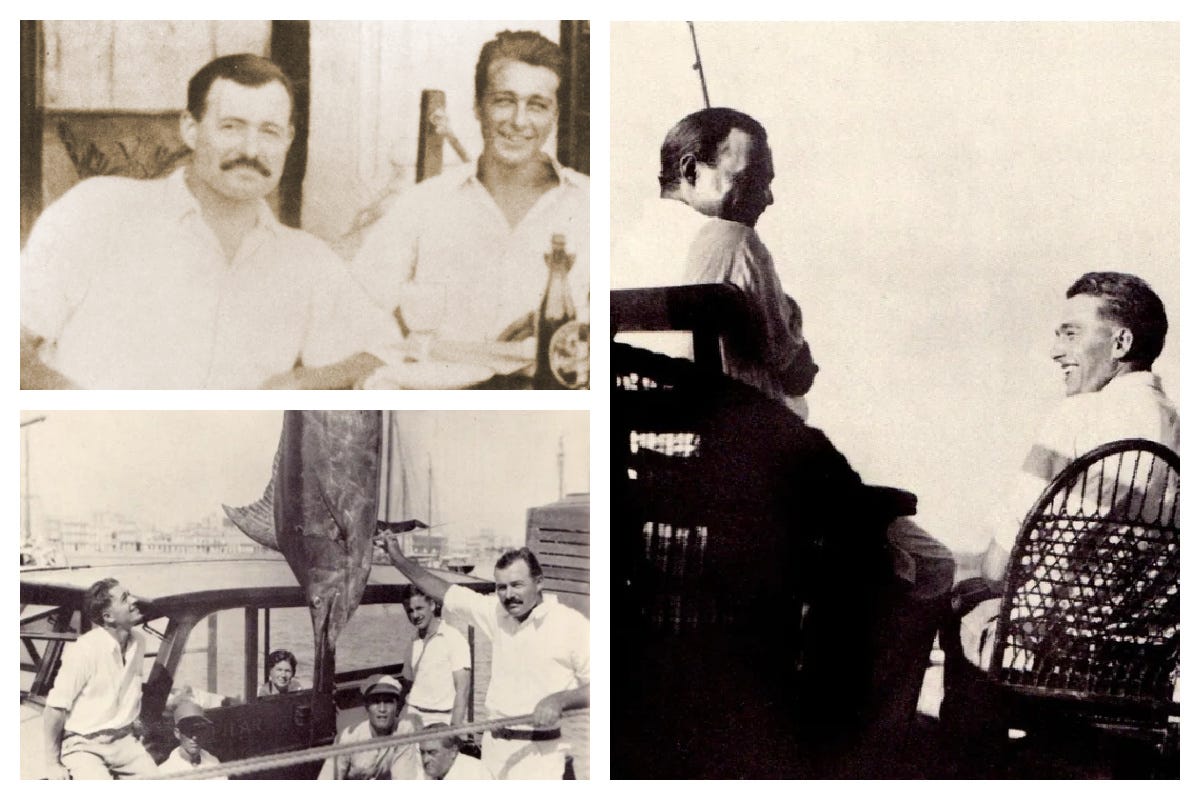
For an entire year, he lived with Hemingway helping around the house, yard and boat and the two men spent a lot of time writing together and talking about writing.
Hemingway told him writing is a tough racket. You gotta learn to write, and you do that by reading. He made a list of books Arnold should read and lent him all those books from from his own library. Said send them back when you’re done reading.
I saw a scan of the handwritten list and it was fun to see, but the particular books aren’t what really mattered. Hemingway just picked a dozen books he thought were well written. The point was learning from good examples.
Writers have always said that. Stephen King says the same thing.
After Arnold left, he kept sending essays to magazines and papers. Every once in a while he’d appear in some big magazine like Esquire and then he’d get a letter in the mail from Hemingway, congratulating him and saying keep on writing. They stayed in touch for years. The master and his student.
He lived a pretty ordinary life. Got married, worked jobs, sent off writing now and then always hoping for his big break but it never came.
When he died in 1981, his daughter found a manuscript tucked in a trunk.
It was called With Hemingway: A Year in Key West and Cuba. The trunk was full of notes, letters, photos — and the manuscript. Written when he got back and the memories were fresh. It was a bit rough, she said, just needed a good editor.
The hardcover was published in 1984. Sold out so they did another print run. Couple of years later, the paperback came out. Had to reprint that, too. I couldn’t find record of how many copies sold. What I do know is it’s out of print now and copies are ridiculously expensive if you can find one.
And I can’t help but wonder why he just put that book in a trunk.
Did he think the same thing so many writers tell me?
Did he wonder who’d want to read a book by a nobody writer who never made it?
I don’t know. But I think writers do themselves a disservice to think it’s “us” no one wants to read. Not everyone is called to write and I think the people who are drawn to words are drawn to them because we have stories to tell. And they matter.
How we tell those stories is another thing, entirely. I think Hemingway was right when he said we need to learn to write.
When I worked in the publishing industry as an editor, I saw tons of great stories that just needed a little feedback. Little things, like changing passive voice to active or maybe changing first person to third, or third person to first, depending on the story.
You’d be surprised how often cutting the first paragraph makes a good story great.
Just a bunch of little things an editor can see that the writer can’t because they’re too close to the words to be objective.
I think writers who write online would be astounded at how often a better title makes a world of difference and can take a piece from no views to oh my god.
But to think it’s you? I don’t think it is. You’re called to words for a reason.
Here’s what I tell everyone who writes to me and asks what they can offer the world that someone else hasn’t already written. I tell them what they bring is the view through their eyes. No one else has brought that. No one else ever can.
And I think once we can stop questioning ourselves, we can start questioning the things that can make all the difference. The words, the edits, the titles.
Because like Hemingway told a 22 year old boy who hitchhiked two thousand miles to meet him, we’re all apprentices at a trade that has no masters. Keep writing.
As always, I’d love to know what you think…

This is so true! I began to think about writing when I was a teenager, but my education was terrible and my family life overwhelming, so I quit high school, completed my GED, and went to work so I could escape the drama. I had convinced myself that I didn't have the skills to write because I struggle with spelling, grammar, and comma rules. Starting college at age 25 was terrifying, and I will always be grateful to an English professor who told me my voice was there waiting to come out. It still took another decade for me to trust my voice. Nothing wrong with late blooming. The point is to bloom.
This is the best piece I’ve read on Substack so far. Thank you.