
No, Mary Shelley's Frankenstein doesn't really test positive for AI
We need to talk about how AI detection really works

Y’all, the world is nuts. We live in a ridiculous time where we can’t believe anything and it sucks. It does. It sucks to question everything because you can’t even believe your own eyes anymore and everything has to be taken with a giant grain of salt.
But here, let me make sense. I saw a Note that said Mary Shelley’s Frankenstein tested as 100% AI, and it had a screencap. Yay proof, right? And the conclusion drawn, authors are going to get screwed, Ai witch hunts, blah blah. 6.5K hearts. See?
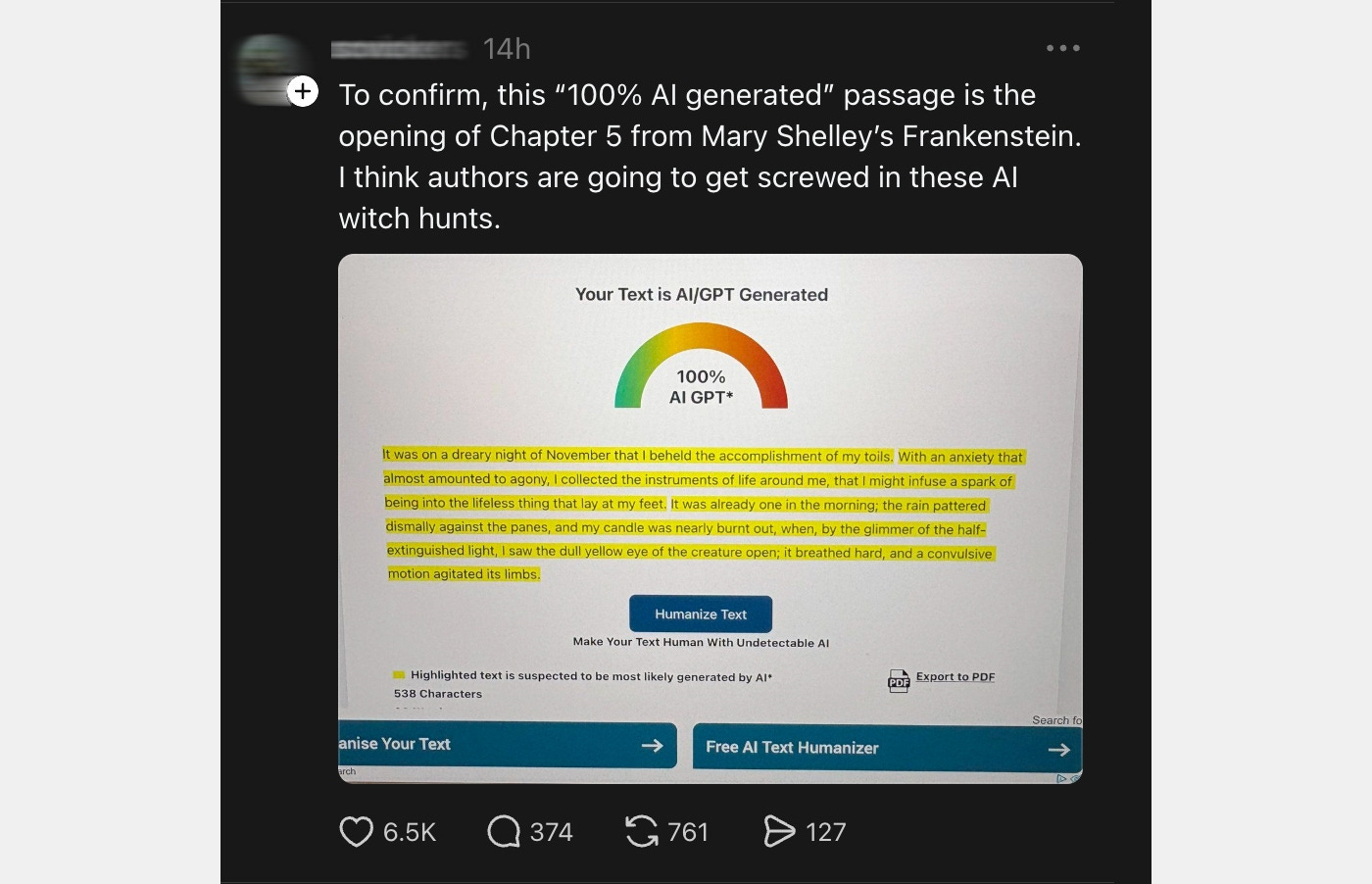
Fyi, I blurred the profile name and photo because this isn’t about pointing fingers. If you’ve been reading me a while, you know we don’t do naming or shaming here so please don’t name in comments or I’ll delete them. We look at what, not who.
First, we’re going to talk about why this screencap exists. Then we’re going to talk about these so called AI witch hunts, okay? Because I hear that a lot.
So let’s investigate, okay? Because you need to know what’s happening here.
First I went to the original copy of Frankenstein on Gutenberg. I went to chapter five and grabbed the exact text used in this test and pasted it into GPTZero which is decent at AI detection. Not excellent, but decent. See the red arrow?
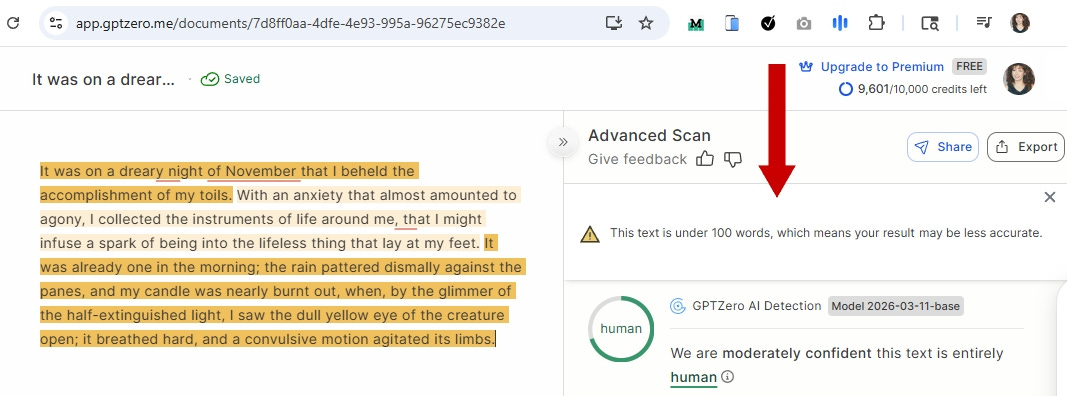
The text is under 100 words, so it tells me the score will be less accurate. But even still, it’s moderately confident the text is entirely human. As it should be, lol.
Know why 100 words matters? It’s a bare minimum. 200 words is a bit better and 500 words would be a lot better. But do you know why?
AI detection tools are built starting with the same technology that powers AI. When AI was created, it was open source. So anyone can take the bones of it and build their own thing. Like AI for approving insurance. Or AI for sorting resumes.
Some companies chose to built tools that use AI to detect AI.
AI detection tools aren’t just trained on human writing. They are intentionally fed a second set of data that’s AI generated so they can learn to distinguish between the two. To see patterns in actual human writing versus the patterns of AI trying to emulate human writing. Make sense? We’ll come back to this later, okay?
We know not all tools are the same quality, right? Not drills or saws, not paint or pencils, or sewing machines or tractors. We’ll come back to this too, okay?
So I went back to chapter five of Frankenstein and grabbed the second paragraph. With two paragraphs, I had 203 words to work with. Then I tested it in seven AI detection programs. Not one. SEVEN. Here. Let me show you the results.
The Seven Tests…
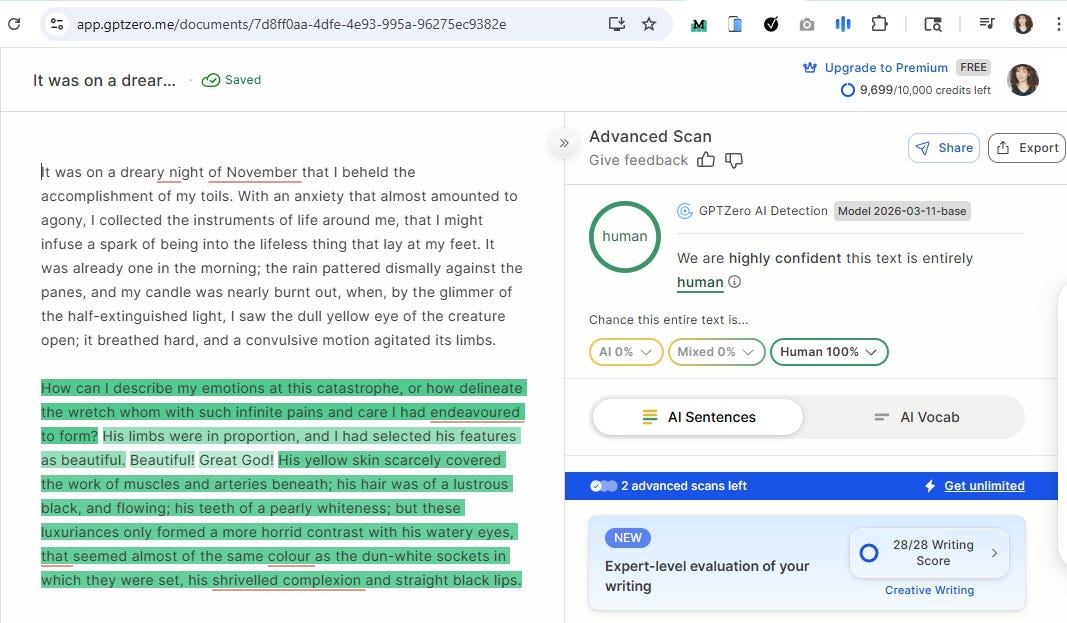
1) GPT Zero: 100% Human
I refreshed the page on GPT Zero and pasted in two paragraphs. Voila. 100% human.
. . .
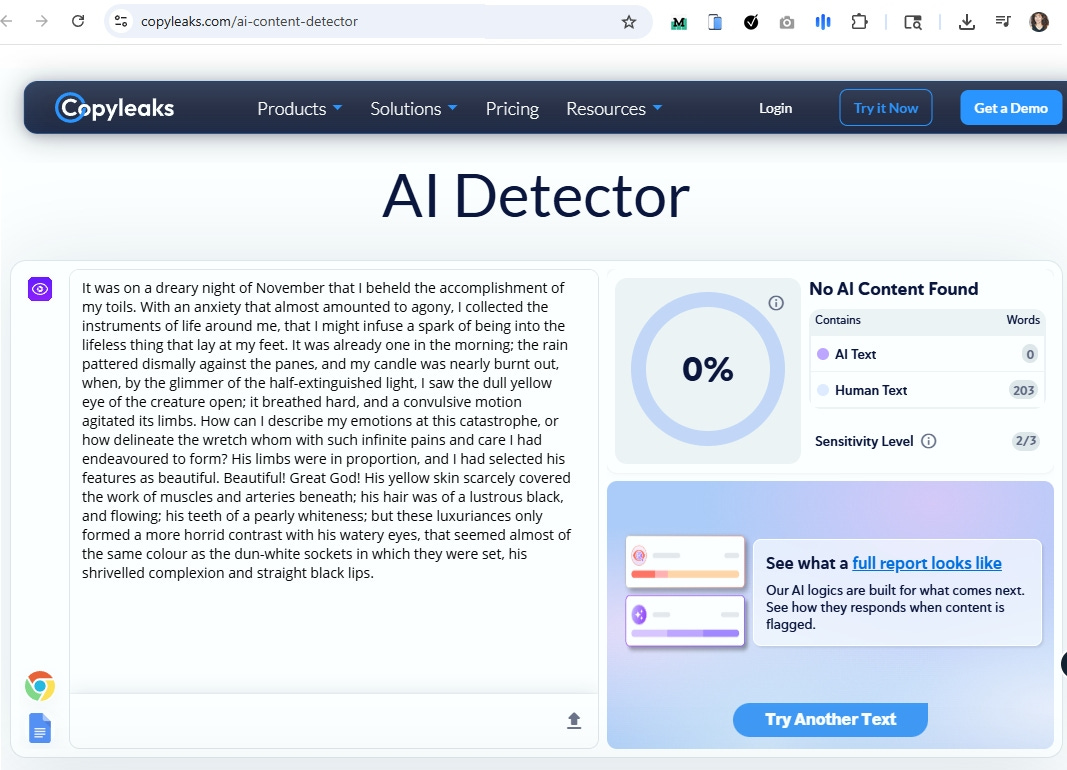
2) Copyleaks: No AI Content Found
Copyleaks also said no AI content found here. This is human writing.
. . .
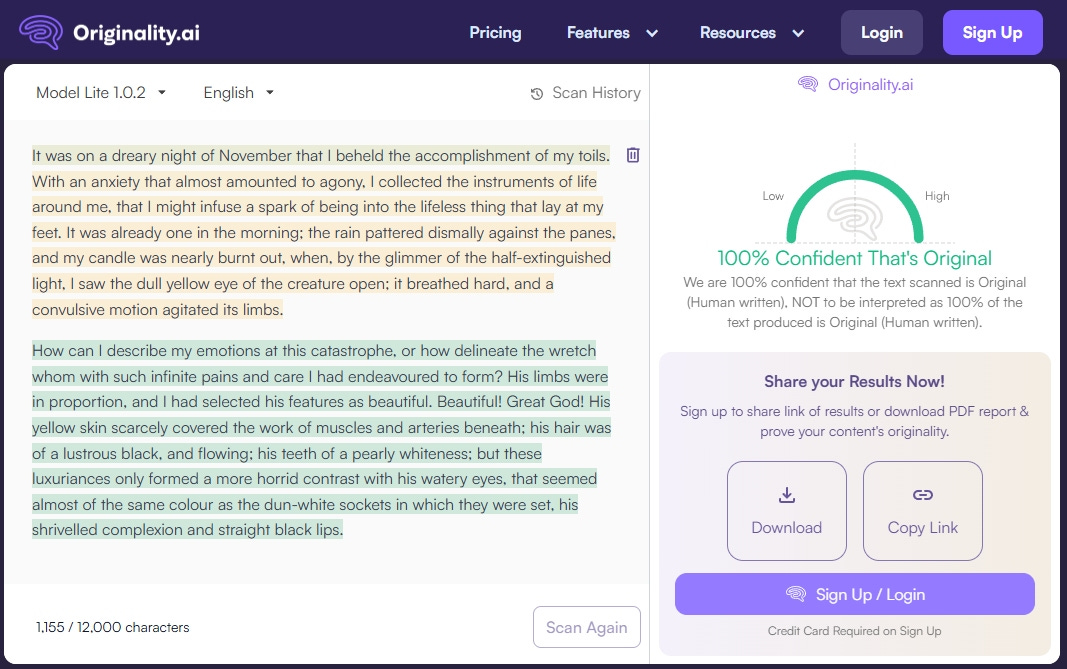
3) Originality.ai: 100% Confident That’s Original
Originality.ai also said they’re 100% confident that’s original writing. Yup, it’s human.
. . .
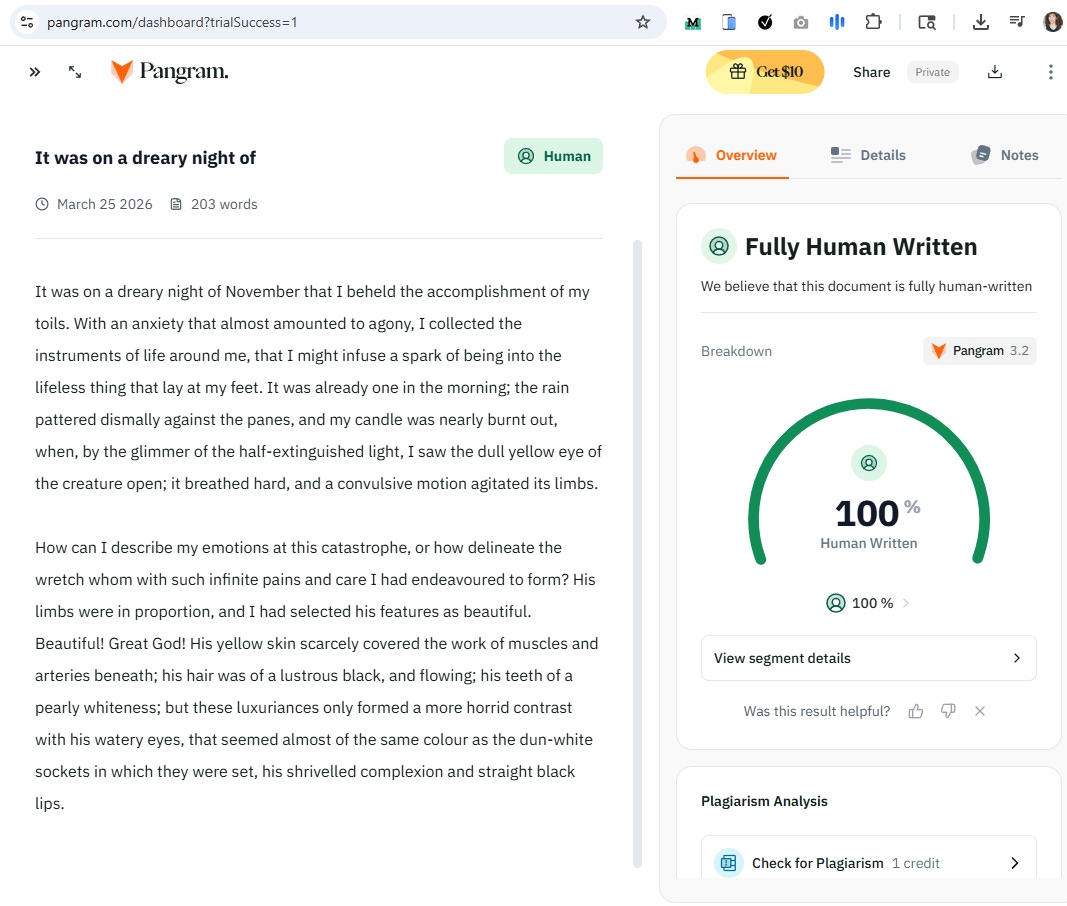
4) Pangram: Fully Human Written
Pangram is a tool made for the education system. It also said 100% human writing.
. . .
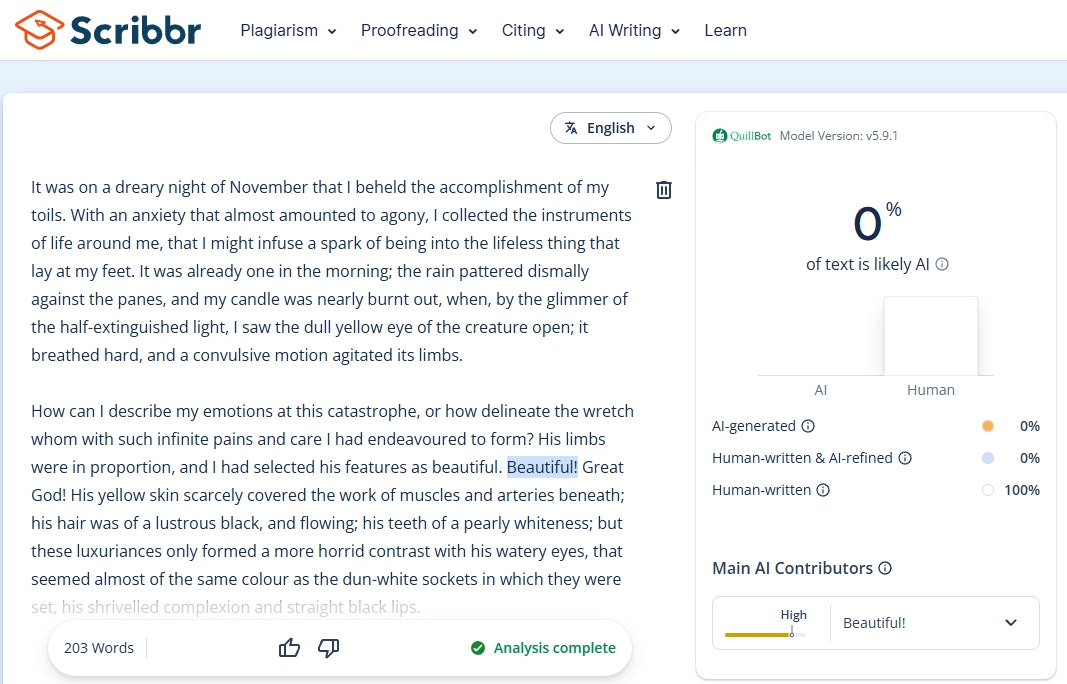
5) Scribbr: 0% AI
Scribbr is a toss up if you paste in actual AI, but it does okay at knowing human text. And sure enough, it scored the text as 0% odds this is AI generated. lol the single word it highlighted. Beautiful! (This will make sense shortly, too)
. . .
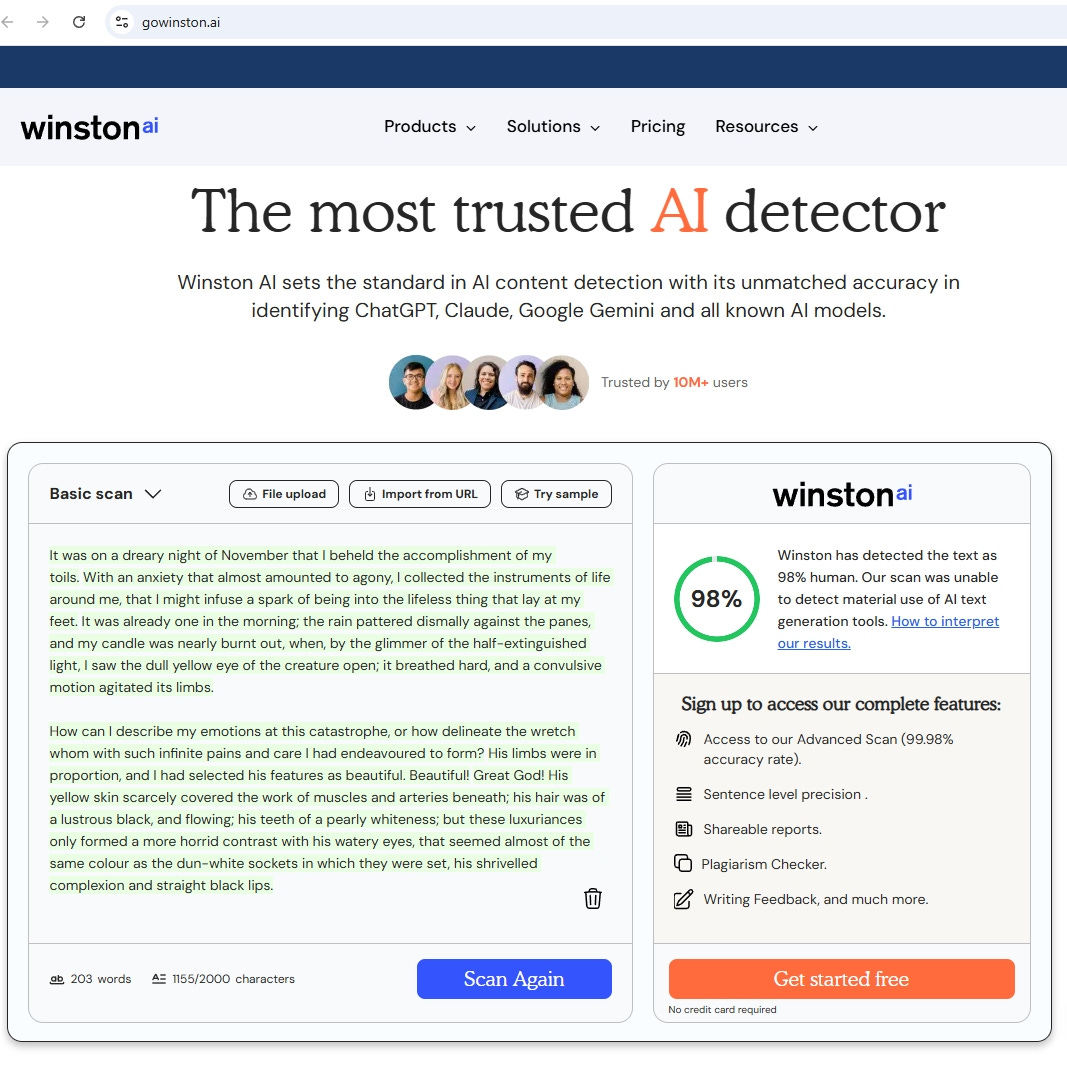
6) Winston ai: 98% Human
Winston gave it a 98% human score, but also said they couldn’t detect any use of AI generation tools. We’ll talk about that in a bit too, okay?
7) ZeroGPT: 99% AI
Well lookie, lookie, would you look at that? This is the screencap from that Note. Notice the blue button at the bottom? We should talk about that…
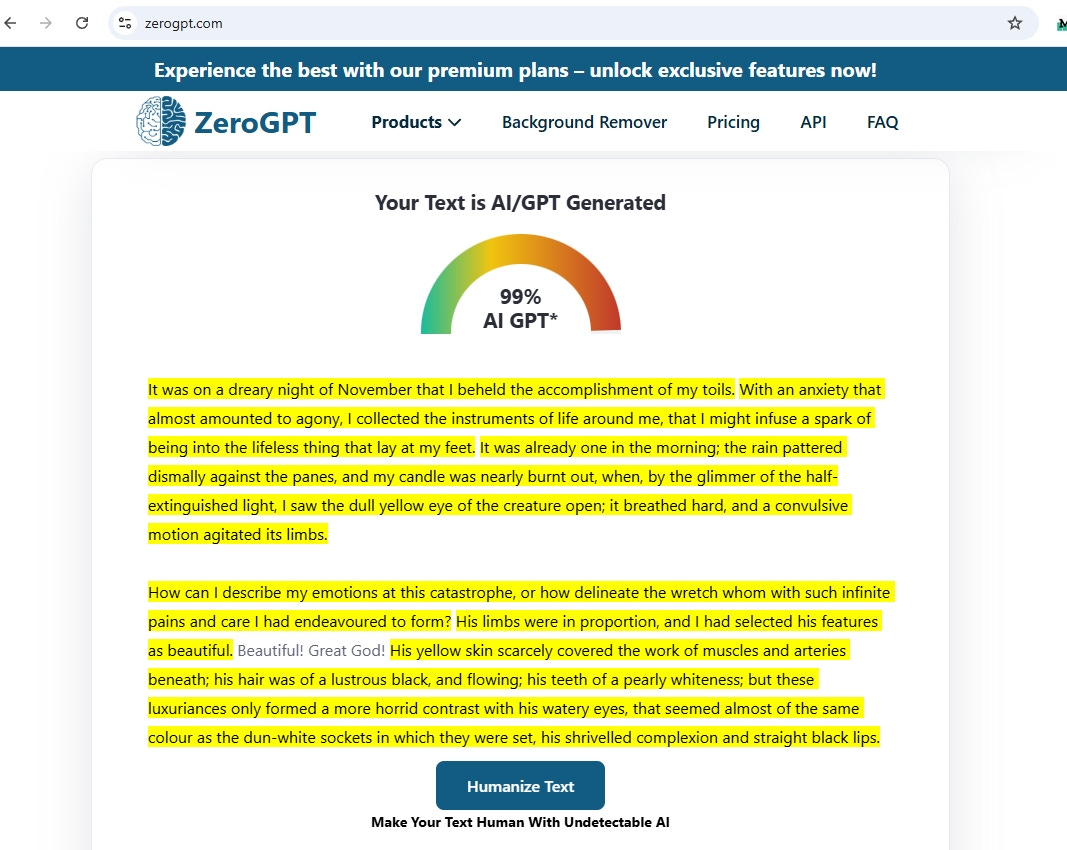
Know what happens if you click that blue button?
First, it goes to a screen that says you can humanize any AI text instantly with no manual rewriting required. But as soon as you try to paste in any text, it flips to a screen that offers a 3 day free trial before your credit card is billed.
One more quick test… for plagiarism!
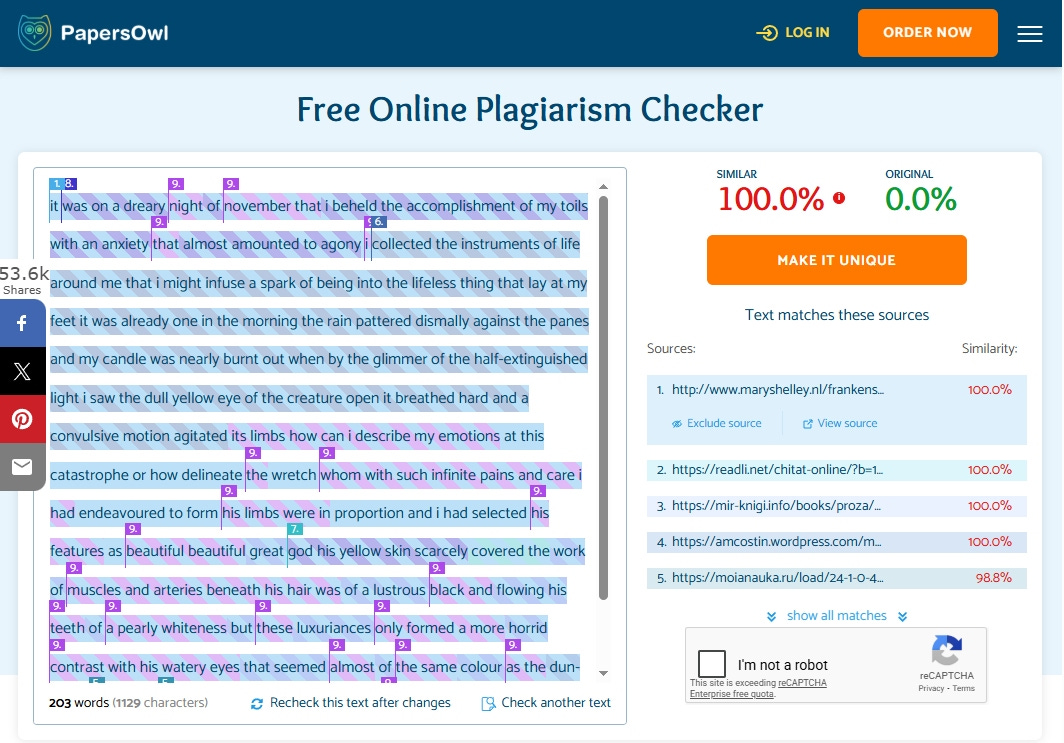
I won’t paste in six more screencaps, lol. I pasted the two paragraphs into plagiarism testers. You know they’re AI right? There’s no human hiding in a closet searching the internet. It’s an AI tool. And they know what this is. Some linked to Gutenberg. Most linked to the Mary Shelley website. They know this is her work. They know.
You know what sucks? That big orange button. MAKE IT UNIQUE.
A lot of companies are real eager to rewrite other people’s writing for you.
Can we talk about those witch hunts now?
God, I hate that phrase. Because you know what the witch hunts were. Persecution of innocent women for anything that defied patriarchal society. That’s fact. Her husband died and left her money and she has no son? Hang her, take the money. She got pregnant unmarried? Hang her, let some “decent” person raise that child.
I could write more, and I have. I’ve been writing feminism online since 1998. Like this one — the top 10 reasons women got locked in asylums.
Which are pretty much that same as the top 10 reasons women were tried as witches. Writing the same stuff for print magazines before the internet. Literally decades.
They were innocent. The women who were witch hunted.
But the people using that phrase? Funny how they’re never innocent.
Think about the people using that phrase in politics. And when it comes to AI, they’re usually trying to pass off AI as human writing and it p*sses me off.
Look, I don’t care, okay? You want to use AI to write, that’s your business. Because I can smell it a mile away and it’s not because of em-dashes. It’s because AI has a surface profundity that human writing does not and I don’t want to read it.
There’s no witch hunt.
But they’re doing a good job of making people think there is.
Yesterday I read a post that broke my damn heart. This poor woman. Just, wow.
It was an author who ran her manuscript through AI detection and got a 98.7% human score so she’s re-writing and re-writing, agonizing about that 1.3% because she is terrified she’ll get witch hunted. That someone will see that her score isn’t 100% human and think she used AI and it hurts my heart and I’m so damn angry.
Because as she’s doing that? She’s training AI on her own writing and I could weep. Stop. Please stop. Stop feeding your work to AI when you KNOW it’s yours.
We need to stop the insanity but how are we to do that when people blindly believe what they see on social media and the internet and Notes and over 6,500 people heart a Note like that because they think it means something it doesn’t?
Look, here’s the truth about how AI detection works. They have 2 data-sets of text. One set is human text, written before there was AI. The other is 100% AI generated text, which means basically AI emulating human writing.
Their job is to seek patterns and then use those patterns to try figure out if any given piece of work is human, AI, or a combination. And look, there is going to be crossover. There’s going to be false positives. A 98.7% human score doesn’t mean you used AI. It means that 1.3% of the writing follows patterns that AI has learned from humans.
Just like the word Beautiful! — highlighted in blue.
You know the two datasets? One of human writing and the other of AI generated text?That would appear in both of them. A one word sentence with an exclamation mark. Beautiful! Amazing! Incredible! That “pattern” is in both human and AI datasets.
People keep screaming AI detection doesn’t work but often they don’t understand how it works in the first place. They think it’s “judging” and take it personal.
No. If you’re a human and got a 98% human and 2% AI score, that does not mean it’s saying you used AI. It’s saying 98% of your writing follows the patterns seen in the human writing dataset, and 2% of it is also found in the AI generated dataset.
Like a single word with an exclamation mark. Like using the rule of three excessively. Like using 30% more em-dashes than are found in the human dataset.
If you get a score of 98% AI and 2% human it means 98% of your writing falls into the patterns seen in the AI dataset and only 2% is exclusive to the human dataset.
But the tool matters. It really, really matters. Because if you’re using a tool that was created to sell a rewriting tool, then all bets are off. Roll the dice, spin the wheel. It’s going to score writing with the aim of getting you to click the “humanize” button.
Let me paint an ugly picture that happens every day…
Someone goes to my writing on Medium. They see that it has thousands of views. Must have paid well, yeah? So they grab my article. Paste it into some dicey tool that tells them it’s AI. Whew, they think. Good. I can use it. They know it’s a lie. They do. I am far too vocal about not using AI. But the tool tells them what they want to hear.
So they hit the button to “humanize” it.
Cha-chang, the tool rewrites my article, which is no more AI than Mary Shelley’s.
A few hours later, or the next day, it appears on Medium. Where I have 65,000 readers so someone reaches out and says hey Linda, there’s an AI knockoff of your piece online, you might want to report it. So I do. It’s removed. And the next week it happens again. And again. And again. Like playing whack-a-mole.
I never bother to reach out. I just report.
Once I did. Asked one guy why he thinks it’s okay to steal my work. He replied to say so sorry, only I take AI is public domain, is okay. No. Sorry. I got him shut down.
Here’s the thing about AI detection. They have to change constantly, because AI changes constantly. Not big changes like from GPT4 to GPT5. But little incremental changes that happen within a version. They eat more text. Change in tiny ways. And the AI detection tools need to keep up. Some keep up well. Others do not.
Anyone who has a vested interest has to keep up, too. Know which tools are giving accurate results at any given time. It’s yet another game of whack-a-mole.
And yes, there are false positives. They are not an accusation. They are an observation of what percent falls into the patterns in the AI generated dataset vs the human one.
But to use a dicey tool and scream about witch hunts? No. Sorry.
No, Mary Shelley’s Frankenstein does not test positive for AI. Not in any legitimate tool. And to say it does is either misunderstanding or misleading and I don’t know which it was. What I do know is that we cannot walk around assuming everyone has the same knowledge, morals or even motivation as we do. Because they don’t.

As a rule, I don’t ask you to restack. But this time I’m asking. If you learned anything you didn’t know from this post, please restack. We need more understanding and less screaming about witch hunts. Please. Help me reach more readers with this one. xo
This wouldn't have anything to do with "Frankenstein" being written by a woman, would it?
Although, if you think about it, the story is about the 19th century equivalent of AI...
What about those of us that are part of the Anthropic copyright lawsuit? Our books were used to teach AI our patterns. People say AI uses lots of emdashes. Well, so do I--at least I did until they started to say emdash usage means AI. Where did AI learn about the emdash? Where did AI learn about any of the patterns it uses?
The example you used for AI is from a book used 200 years ago. Writing styles have changed drastically in that time. I'm not surprised the AI said 100% human. Take a contemporary book. AI will look at the style and will be more inclined to say a part is AI generated because AI doesn't write in the style of 200 years ago, it writes in the style of today.